Alaska Earthquakes– Current Map & Updates
M4.30 104 km SSE of Akhiok, Alaska
20 hours ago · Depth 37.1 km
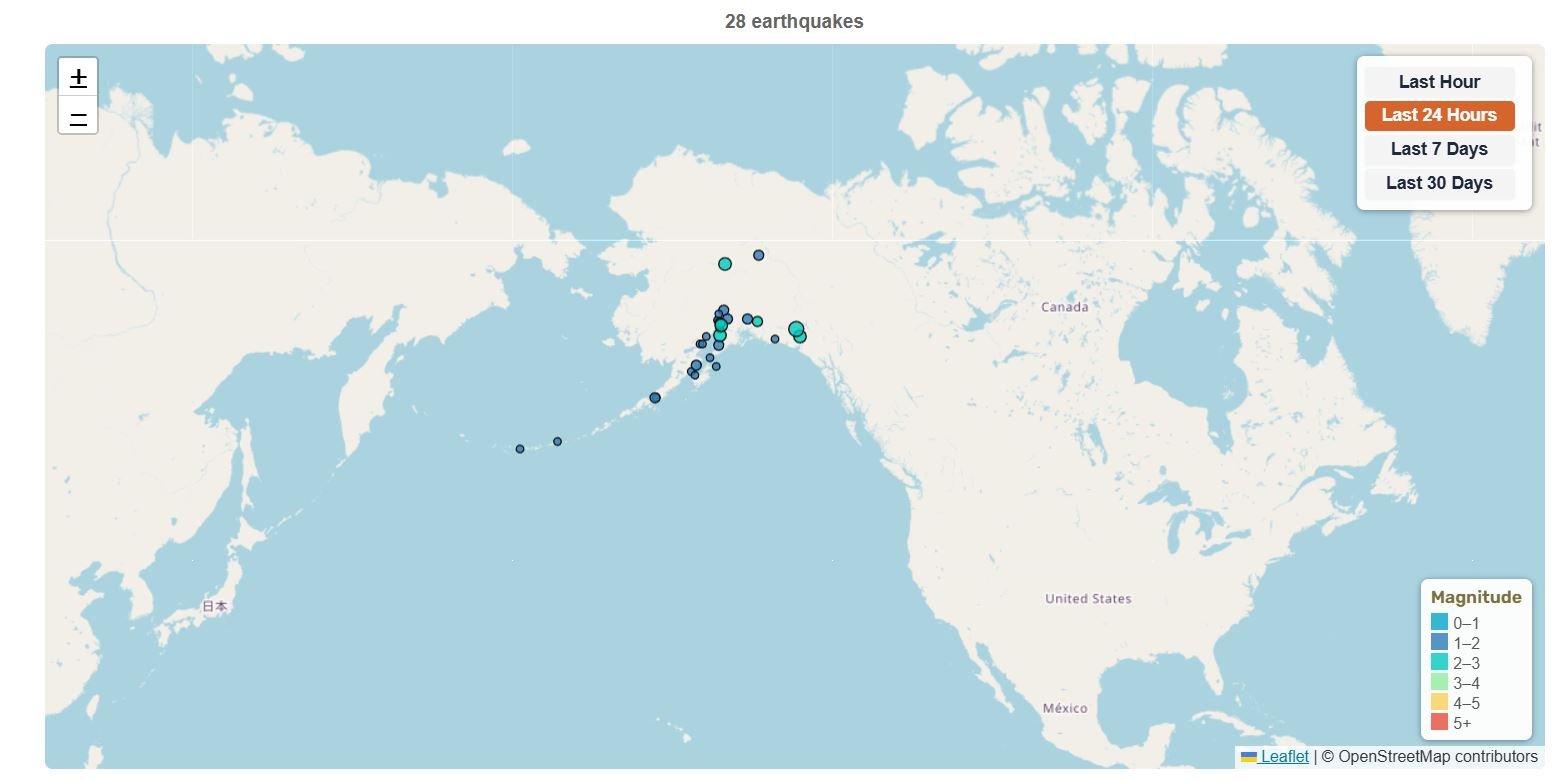
Recent Alaska Earthquakes (Past 24 Hours)
- M2.1083 km N of Karluk, Alaska
- M1.6040 km E of Chase, Alaska
- M1.7023 km WNW of Ivanof Bay, Alaska
- M2.00109 km WNW of Yakutat, Alaska
- M1.7029 km W of Anderson, Alaska
- M2.0065 km W of Tyonek, Alaska
- M2.0052 km WNW of Happy Valley, Alaska
- M1.7019 km N of Sterling, Alaska
- M1.6070 km NW of Aleneva, Alaska
- M1.9018 km W of Chenega, Alaska
- M1.7073 km N of Aleneva, Alaska
- M1.8014 km NE of Susitna, Alaska
- M1.5061 km ENE of Pedro Bay, Alaska
- M2.1072 km SE of Denali National Park, Alaska
- M2.2048 km W of Karluk, Alaska
Source: USGS
Monitor the most recent earthquake activity across Alaska, the most seismically active state in the United States. This page features up to date USGS data for all magnitude 1.5+ earthquakes. Alaska sits in a powerful tectonic setting along with Pacific Ring of Fire, where the Pacific Plate subducts beneath the North Amercan Plate at the Aleutian Trench. This convergent boundary produces frequent, mostly shallow to intermediate-depth earthquakes, including some of the largest on Earth, which shape the state’s seismic landscape1.
Understanding the Map
Each colored circle represents an earthquake location. Click any circle to see detailed information including magnitude, location, time, and depth. Use the time filter buttons to view earthquakes from the last hour, 24 hours, 7 days, or 30 days. Alaska typically shows dozens of earthquakes daily, with particularly high activity along the Aleutian arc. Counts and map data update when the page is refreshed.
Alaska earthquakes (map loads with JavaScript)
📊 Alaska Earthquake Statistics
104 km SSE of Akhiok, Alaska
90 km SSE of False Pass, Alaska
90 km SSE of False Pass, Alaska
2025 Hubbard Glacier Earthquake
Magnitude 1.5+ • Data from USGS
🔔 Latest Alaska Earthquakes (M4.0+)
| Mag | Location | Date & Time | Depth |
|---|---|---|---|
| M4.00 | 102 km SSE of Akhiok, Alaska | Jul 18, 2026, 10:00 AM UTC | 23.9 km |
| M4.30 | 104 km SSE of Akhiok, Alaska | Jul 18, 2026, 7:20 AM UTC | 37.1 km |
| M5.20 | 122 km SE of McCarthy, Alaska | Jul 16, 2026, 11:37 AM UTC | 8.5 km |
| M4.90 | 106 km NNW of Aleknagik, Alaska | Jul 16, 2026, 2:07 AM UTC | 3.2 km |
| M4.30 | south of Alaska | Jul 15, 2026, 5:46 PM UTC | 25.5 km |
| M5.40 | 90 km SSE of False Pass, Alaska | Jul 14, 2026, 6:51 PM UTC | 47.0 km |
| M4.30 | 94 km SE of False Pass, Alaska | Jul 14, 2026, 4:28 PM UTC | 44.0 km |
| M5.30 | 96 km SE of False Pass, Alaska | Jul 14, 2026, 12:12 PM UTC | 40.8 km |
| M4.20 | 37 km WSW of Anchor Point, Alaska | Jul 12, 2026, 10:11 PM UTC | 79.0 km |
| M4.50 | 27 km SSW of Unalaska, Alaska | Jul 12, 2026, 11:23 AM UTC | 95.2 km |
Updated: Jul 19, 2026, 4:00 AM UTC
About Alaska Earthquakes
Alaska is North America’s most seismically active region, with more large earthquakes than all other U.S. states combined. On average, Alaska experiences about one magnitude 7+ earthquake per year and a magnitude 8 or larger roughly every 13 years, caused by rapid plate convergence along the 2,500-mile-long Alaska-Aleutian subduction zone2.
Major Seismic Zones
- Aleutian Megathrust: Subduction zone capable of magnitude 9+ earthquakes, extends from Alaska Peninsula through Aleutian Islands
- Denali Fault: Major strike-slip fault through central Alaska, source of the 2002 M7.9 earthquake
- Castle Mountain Fault: Active fault system north of Anchorage with documented Holocene activity and significant hazard potential3.
- Queen Charlotte-Fairweather Fault: Fast‑slipping transform plate‑boundary fault along the Alaska-Canada border
- Cook Inlet: Seismically active area that includes Anchorage and nearby communities, affected by both crustal and subduction‑related earthquakes.
- Interior Alaska: Region of frequent earthquake swarms and seismicity, including events related to both tectonic faults and nearby volcanic systems3.
Historical Major Earthquakes
- 1964 Great Alaska (M9.2): Second largest earthquake ever recorded, caused devastating tsunami, 131 deaths in Alaska and along the Pacific.
- 1965 Rat Islands (M8.7): Aleutian Islands megathrust event with 10-meter tsunami4.
- 2002 Denali (M7.9): Largest instrumentally recorded interior Alaska earthquake, rupturing multiple faults including the Denali and Totschunda faults.
- 2018 Anchorage (M7.1): Intraslab event beneath south‑central Alaska that caused extensive damage but no fatalities due to strict building codes.
Earthquake and Tsunami Risk
Alaska faces combined hazards from strong ground shaking, landslides, and tsunamis generated by megathrust earthquakes and coastal or submarine slope failures. The Alaska–Aleutian subduction zone can produce Pacific‑wide tsunamis that threaten coastal communities in Alaska and across the broader Pacific Basin.
Many Alaska coastal communities maintain mapped tsunami hazard zones, signed evacuation routes, and regular community drills to reduce risk. The Alaska Earthquake Center and partner agencies monitor seismic activity 24/7 and provide rapid alerts, products, and information that support tsunami warning operations and public safety messaging.
Why So Many Earthquakes?
Alaska has around 20,000 earthquakes every year, but most are so small that people never feel them. Several magnitude 5+ earthquakes usually occur each month, showing how much strain is constantly building and releasing along the state’s plate boundaries and major faults.
All this shaking comes from where Alaska sits on the planet, right where several plate boundaries meet, including the Alaska–Aleutian subduction zone, major transform faults, and complex fault networks in the interior. This complex tectonic crossroads makes Alaska one of the best places on Earth to study powerful earthquakes, tsunamis, and the hazards that come with them5.
🗺️ Related Maps
View broader region: United States Earthquakes
View other states: California | Washington |
- https://seagrant.uaf.edu/topics/environmental-hazards-alaskas-coasts/earthquakes-tsunamis/
- https://www.usgs.gov/special-topics/subduction-zone-science/science/alaska
- https://dggs.alaska.gov/popular-geology/earthquakes-tsunamis.html
- https://earthquake.usgs.gov/earthquakes/eventpage/official19650204050122_30/region-info
- https://seismic.alaska.gov/earthquake-risk.html